
When we moved to Tenerife in 2022, I thought I understood what “carnival” meant. We have celebrations in Hungary, after all. But nothing—and I mean nothing—prepared me for the scale, passion, and sheer exhaustion of Tenerife carnival. Now that we’re planning for our fifth carnival season here, I want to share what I’ve learned about the Tenerife carnival 2026 dates and what actually happens during those weeks that turn the entire island upside down.
The official Tenerife carnival 2026 dates haven’t been announced yet as I write this in early 2025, but I can tell you with confidence they’ll fall somewhere between late February and early March. The carnival always happens in the weeks leading up to Lent, so once the Easter date is set, you can work backwards. For 2026, expect the main events to run approximately from February 19th through March 1st, with the grand parade likely on February 27th or 28th.
But here’s what the official dates don’t tell you: carnival doesn’t just happen during those two weeks. It’s a beast that takes over the island for nearly a month.
What the dates actually mean (and don’t mean)
Our first year here, I looked at the official carnival dates and thought, “Okay, two weeks of festivities, we can handle that.” Our Canarian neighbor María laughed when I told her this. “Two weeks?” she said. “The murgas start rehearsing in December. The costumes are ready by January. And the cleanup? That takes until April.”
She wasn’t exaggerating. The Tenerife carnival 2026 dates will mark the official events—the galas, the main parades, the competitions. But the actual carnival atmosphere starts building weeks earlier and lingers long after.
In practical terms, here’s how it typically breaks down:
- Early February: Preliminary competitions begin, especially for murgas (satirical singing groups) and comparsas (dance groups)
- Mid-February: The Gala Elección de la Reina (Queen Election Gala) happens, usually about two weeks before the main parade
- Late February: The official carnival week begins with the opening parade (Cabalgata Anunciadora)
- Final week: The massive Coso (main parade), street parties every night, and finally the Entierro de la Sardina (Burial of the Sardine) to close everything
For 2026, mark your calendar for the last two weeks of February through the first days of March. But if you’re planning to visit or—like us—you’re trying to maintain some semblance of normal life while living here, understand that the island starts shifting into carnival mode well before the official dates.
The queen gala: where it really begins
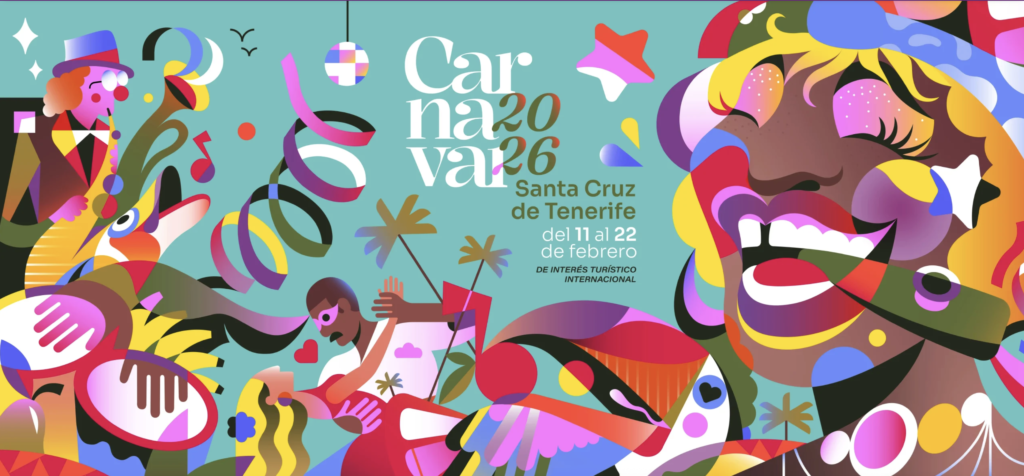
The first major event is always the Gala Elección de la Reina del Carnaval. This typically happens about 10-14 days before the main carnival week kicks off. For 2026, I’d estimate this will be around February 13th or 14th, though the exact date usually gets announced in November or December 2025.
I’ll be honest: we didn’t attend the queen gala our first year because I thought it was just a beauty pageant. I was completely wrong. This is a spectacular theatrical production where contestants wear costumes that can weigh up to 100 kilograms, some reaching five or six meters tall. The engineering alone is mind-blowing.
The gala takes place in the Recinto Ferial in Santa Cruz and lasts for hours—usually starting around 9 PM and going until 2 or 3 AM. Tickets sell out fast, especially for the better seats. A local friend told us that many Canarian families consider this the true start of carnival, more important even than the big parade.
If you want to attend in 2026, start checking the official Santa Cruz carnival website around October 2025. Tickets typically go on sale in December or January.
What we learned about getting tickets
Our second year here, we tried to buy queen gala tickets two weeks before the event. Everything decent was sold out. We ended up in seats so far back we could barely see the stage, even with binoculars.
Now we know: if you want good seats, buy tickets the day they go on sale. Yes, it means committing months in advance before you know the exact Tenerife carnival 2026 dates, but it’s worth it. The alternative is standing-room sections, which are cheaper but mean standing for five or six hours straight.
The opening parade and street carnival
The official carnival week usually starts on a Friday with the Cabalgata Anunciadora—the opening parade. This is smaller than the main parade but still impressive, with groups showcasing their costumes and warming up the crowds.
What caught us off guard was the street carnival that starts the same night. And when I say “street carnival,” I don’t mean a few people in costumes having drinks. I mean tens of thousands of people flooding the streets of Santa Cruz, music blasting from every corner, bars overflowing, and the entire city center transformed into one massive party.
This happens every single night during carnival week. Every. Single. Night.
Gábor and I tried to go out for all of it our first year. By Wednesday, we were completely destroyed. Our middle daughter, who was 13 at the time, had more stamina than both of us combined. Now we pace ourselves—we pick two or three nights to really commit to, and the rest we enjoy from our balcony with a glass of wine.
The murgas and comparsas
During the week leading up to the main parade, there are competitions for murgas and comparsas. These usually happen in the late afternoon and evening at various locations around Santa Cruz.
Murgas are groups that perform satirical songs about politics, local issues, and current events—all in Spanish with heavy Canarian dialect. I’ll be honest: even after three years of Spanish lessons, I catch maybe 60% of what they’re saying. But the energy is incredible, and locals absolutely love them. Our neighbor says the murgas are the soul of carnival, more important than all the fancy costumes.
Comparsas are the dance groups with elaborate matching costumes. These are more accessible if you don’t speak perfect Spanish—the spectacle speaks for itself. The rhythm, the coordination, the costumes catching the light… it’s genuinely beautiful.
The main parade: Coso Apoteosis
The Coso—the main carnival parade—typically happens on the Tuesday of carnival week. For the Tenerife carnival 2026 dates, this will likely be Tuesday, February 24th, though again, this won’t be confirmed until late 2025.
This parade is the big one. It starts in the late afternoon (usually around 5 or 6 PM) and goes until midnight or later. The route runs through central Santa Cruz, and literally hundreds of thousands of people line the streets to watch.
We made a €200 mistake our first year by not reserving grandstand seats. We thought we’d just show up and find a spot to watch. We ended up standing for seven hours, our youngest daughter on Gábor’s shoulders, barely able to see over the crowds. Our feet hurt for three days afterward.
Now we know: either buy grandstand tickets (they go on sale around the same time as the queen gala tickets) or claim your street spot by 2 PM at the latest. Yes, that means standing around for hours before the parade starts, but at least you’ll have a view.
What actually happens in the parade
The parade includes all the major comparsas, the queen and her court on massive floats, visiting groups from other islands and countries, and thousands of participants in costumes ranging from elaborate feathered creations to hilarious satirical outfits.
Between groups, there are often gaps—sometimes 10 or 15 minutes with nothing happening. This threw us off the first time. We thought the parade was over and started to leave, only to have another wave of performers appear. The whole thing has a wonderfully chaotic energy that’s very different from the organized precision of, say, a German festival.
Bring snacks, water, and layers of clothing. It can be warm during the day but gets surprisingly cool once the sun sets, especially if you’re standing still for hours. And for the love of everything, wear comfortable shoes.
After the parade: the real party begins
After the main parade ends, the street party intensifies. The Plaza de España, the Avenida de Anaga, the entire old town—it all becomes one massive celebration. Music everywhere, people in costumes (or half-costumes by this point), bars serving until dawn.
A German couple we met, who’ve been here for 15 years, told us that Tuesday night after the Coso is when the real locals come out to party. The earlier nights have more tourists and families; Tuesday night is when Canarians who’ve been performing in the parade finally get to celebrate.
We usually head home by 1 or 2 AM because we’re old and have kids, but the party continues until sunrise and beyond. The next morning, walking through Santa Cruz is surreal—costume pieces scattered everywhere, the smell of street food and spilled drinks, and exhausted but happy people stumbling home.
The burial of the sardine: carnival’s strange ending
Carnival officially ends with the Entierro de la Sardina—the Burial of the Sardine—which happens on the Sunday after the main parade. For 2026, this will likely be Sunday, March 1st.
This tradition is wonderfully bizarre. A giant papier-mâché sardine is paraded through the streets, followed by “mourners” in black (often men dressed as widows), and then the sardine is ceremonially burned. According to our neighbor María, the tradition symbolizes the end of carnival excess and the beginning of Lent, though these days most people just see it as one final excuse to party.
The burial procession has a mock-serious, theatrical quality that’s hilarious if you understand the satire. There are “crying” widows, dramatic speeches, and then—boom—they set the sardine on fire and everyone cheers.
After the burial, there’s usually one more night of street parties, though noticeably smaller than the previous week. By Monday morning, the city crews are out cleaning up, and Santa Cruz slowly returns to normal. Well, normal-ish. It takes a few weeks for everyone to fully recover.
Living through carnival: what they don’t tell you
Since you’re reading a blog about living in the Canaries, not just visiting, let me share what it’s actually like to live through carnival when you’re trying to maintain some routine.
Schools often have carnival celebrations during the week, with kids dressing up and having parties. Our daughters’ schools basically wrote off any serious learning during carnival week. Homework? Forget it. Everyone’s too tired and too distracted.
Getting around Santa Cruz during carnival week is a nightmare. Streets close for the parades and events, parking is impossible, and even the tram gets overwhelmed. We now plan to avoid central Santa Cruz entirely during carnival week unless we’re specifically going to an event. Our grocery shopping, errands, everything gets done either before carnival starts or after it ends.
The noise is constant. We live far enough from the center that we don’t hear the main events, but friends who live in Santa Cruz proper say it’s basically impossible to sleep normally during carnival week. Hotels in the city center are either incredibly expensive or fully booked, and even they can’t guarantee you’ll get much sleep.
The other carnival: Puerto de la Cruz
Here’s something important: while the Tenerife carnival 2026 dates I’ve been discussing refer to the Santa Cruz carnival (the official capital celebration), Puerto de la Cruz on the north side of the island has its own carnival the following week.
This is genius planning by the island—it spreads out the celebrations and gives people who work in carnival productions a chance to participate in both. The Puerto de la Cruz carnival is smaller and, according to some locals, more traditional and family-friendly. We haven’t made it yet because by the time Santa Cruz carnival ends, we’re completely exhausted, but it’s on our list for 2026.
Planning for Tenerife carnival 2026: practical timeline
Based on our years here, here’s when to do what if you’re planning to experience carnival in 2026:
October 2025: Start checking the official carnival website (carnavaldetenerife.com) for announcements. The theme for 2026 will probably be announced around this time.
November-December 2025: Exact dates should be confirmed. Book accommodations immediately if you’re visiting—hotels fill up fast and prices skyrocket during carnival.
December 2025-January 2026: Tickets for the queen gala and grandstand seats for the main parade typically go on sale. Buy early for better seats.
February 2026: The preliminary competitions begin. If you arrive early, you can catch these events which are often less crowded than the main week.
Late February 2026: The official carnival week. Pace yourself, wear comfortable shoes, stay hydrated, and embrace the chaos.
What it costs: the financial reality
Let’s talk money, because carnival can get expensive fast if you’re not careful.
Queen gala tickets range from about €20 for the furthest seats to €100+ for premium seating. Grandstand seats for the main parade are similar—€15-80 depending on location.
If you’re buying costumes to participate (which is half the fun), budget at least €50-100 per person for something decent. Our middle daughter wanted an elaborate costume last year and we spent €180. You can find cheaper options at the markets and shops that pop up selling carnival gear, but quality varies wildly.
Food and drinks during carnival week are expensive. A beer that normally costs €2 might be €4-5 in the carnival zone. A bocadillo that’s usually €3.50 becomes €6. Budget accordingly.
For a family of five trying to do carnival properly—queen gala, main parade with decent seats, some costumes, food and drinks—we typically spend €400-600 for the week. You can do it cheaper by skipping the ticketed events and just enjoying the street carnival, which is free. Or you can spend thousands if you go all-in on everything.
Is it worth it?
After three carnivals here and planning for our fourth in 2026, I can say: absolutely yes, but know what you’re getting into.
Tenerife carnival is loud, chaotic, exhausting, and overwhelming. It’s also joyful, spectacular, and unlike anything else we’ve experienced. Watching our daughters dance in the streets with kids from 23 different nationalities, all in costumes, all just celebrating together—that’s the magic of this place.
The Canarian people’s passion for carnival is infectious. They spend months preparing, pour incredible creativity into their costumes and performances, and then party for two straight weeks with an energy that seems superhuman. As outsiders, we’re learning to appreciate not just the spectacle but the cultural significance—the way carnival lets people express themselves, satirize authority, and come together as a community.
So yes, mark your calendar for the Tenerife carnival 2026 dates when they’re announced. Buy your tickets early. Bring comfortable shoes and an open mind. And prepare for one of the most intense, colorful, exhausting, and absolutely unforgettable experiences of your life.
Just don’t expect to get much sleep. Or to fully recover until April.