
When I first arrived in Tenerife in 2022, I thought I’d just work from our apartment. I run a remote IT business, Gábor does consulting work, and we figured the island’s legendary internet would make everything easy. Turns out, working from home with three daughters—especially during school holidays—is a special kind of chaos that no amount of “please be quiet, Mum’s on a call” can fix.
That’s when I started exploring coworking spaces Tenerife has to offer. And honestly? It’s been a game-changer. Not just for productivity, but for meeting other remote workers, understanding the digital nomad scene here, and finding my people in a new country.
Here’s what I’ve learned after testing most of the major spaces across the island, plus a few hidden gems that even some long-term expats don’t know about.
Why coworking in Tenerife isn’t like coworking anywhere else
Before I dive into specific spaces, you need to understand something: the coworking culture here is different. In Budapest, coworking meant serious tech startups and venture capital meetings. Here, it’s a mix of German developers, British content creators, Spanish entrepreneurs, and people like me who just need reliable WiFi and adult conversation.
The vibe is more relaxed. People actually take lunch breaks. They go for a swim at midday sometimes. A Canarian friend who works at one of the spaces in Santa Cruz told me, “We work to live here, we don’t live to work.” It took me months to adjust to that mindset, but now I get it.
Also, the internet is genuinely excellent. Tenerife has fiber optic infrastructure that puts many European cities to shame. I regularly get 300+ Mbps download speeds at most coworking spaces, which is faster than what I had in Hungary.
The coworking spaces I actually use (and why)
Coworking La Laguna
This was my first coworking space Tenerife experience, and I still use it regularly. Located in San Cristóbal de La Laguna—the historic university town that’s a UNESCO World Heritage site—it’s tucked into a beautiful old building with high ceilings and that particular Canarian architectural charm.
The space is run by locals who genuinely care about building community. They organize networking events, but they’re not the forced, awkward kind. More like “let’s have wine and papas arrugadas on Friday afternoon” gatherings where I’ve actually made friends.
Practical details: €120/month for unlimited access, or €15/day if you want to test it first. The WiFi averages 250 Mbps. There’s a proper coffee machine (not instant, thank god), and the desks have good ergonomic chairs. Parking nearby is tricky, but the tram stops right outside.
The downside? It gets busy during university term time. I’ve shown up at 10am and found all the quiet booths taken. Now I arrive by 9am or work from the open area, which doesn’t bother me anymore.
Coworking Tenerife Sur (Los Cristianos)
When I need to be in the south—usually combining work with picking up our middle daughter from activities—I use this space in Los Cristianos. It’s smaller than La Laguna, more focused on digital nomads than local entrepreneurs.
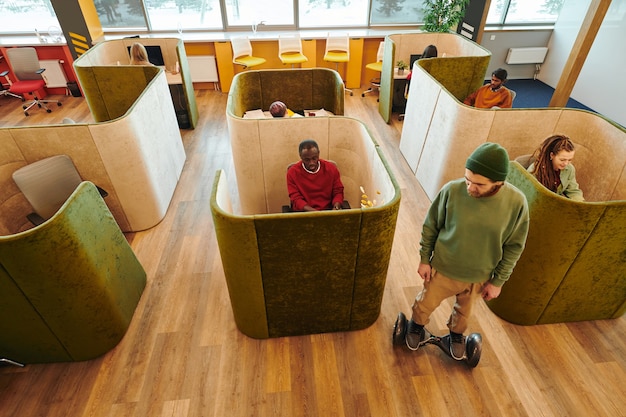
The owner, a German guy who’s been here for eight years, understands exactly what remote workers need. There are standing desks, multiple monitor setups available, and—this is crucial—soundproof phone booths for calls. I’ve taken client meetings from those booths where the person on the other end had no idea I was working from a coworking space.
Cost: €135/month or €18/day. The slightly higher price includes unlimited coffee (good coffee, not the watery stuff), and they stock the kitchen with fruit and snacks. When you’re working long days, that matters more than you’d think.
The location is perfect if you want to swim before or after work. The beach is a five-minute walk. I’ve definitely done the “quick dip at 1pm” thing that seemed so impossible back in Hungary.
Tenerife Coworking (Santa Cruz)
This is the most “professional” of the coworking spaces Tenerife offers. Located in Santa Cruz near the port, it attracts more established businesses and has a slightly more corporate feel. Think less bean bags, more proper office furniture.
I use this space when I need to be really focused or have important client presentations. The internet is phenomenal—I’ve tested up to 500 Mbps—and they have backup generators, so power cuts (rare, but they happen) never interrupt work.
They offer both hot desks and dedicated desks. I have a hot desk membership at €140/month. The dedicated desks are around €220, which includes a lockable drawer and the ability to leave your second monitor there. Some remote workers I’ve met swear by this option.
One thing I love: they have a “silent zone” where talking isn’t allowed. As someone who gets easily distracted, this is golden. The main area allows conversation, but the silent zone is properly enforced.
Impact Hub Tenerife (Candelaria)
This one surprised me. Candelaria is a smaller town famous for its basilica, and I didn’t expect to find such a well-equipped coworking space here. But Impact Hub is part of an international network, and the Tenerife location is genuinely excellent.
What makes it different is the focus on social enterprises and sustainable businesses. They run workshops on circular economy, renewable energy, and social impact. If you’re working on anything related to sustainability, you’ll find your tribe here.
The space itself is modern and bright, with a terrace that has ocean views. On nice days (which is most days), working from that terrace feels almost unfair. €125/month for full access, or they offer part-time packages if you only need a few days per week.
A British couple I met there who work in renewable energy consulting told me they chose this space specifically for the networking opportunities. They’ve landed local clients just through connections made at Impact Hub events.
The smaller spaces worth knowing about
Workstation (Puerto de la Cruz)
If you’re based in the north, this is a solid option. It’s smaller—maybe 15 workstations—but that creates a really tight community. Everyone knows everyone. The owner, a Canarian woman who returned to the island after years in Madrid, runs it with a very personal touch.
€100/month, which is the cheapest I’ve found for unlimited access. The trade-off is fewer amenities—just desks, WiFi, and basic coffee. But the WiFi is reliable (200+ Mbps), and the atmosphere is warm. People look after each other’s stuff, share lunch, that kind of thing.
Puerto de la Cruz itself is less touristy than the south, more authentically Canarian. Working here gives you a different perspective on island life.
Coworking Adeje
This is the newest space I’ve tried, opened just last year. It’s in Adeje, between Los Cristianos and Playa de las Américas. Very modern, lots of natural light, and they’ve clearly learned from other coworking spaces’ mistakes.
The meeting rooms are actually soundproof (not all spaces get this right). They have a mothers’ room—yes, really—with a comfortable chair and privacy for nursing mothers. As a mum, I appreciate when spaces think about these details.
€130/month or €16/day. They’re still building their community, so it’s quieter than established spaces. Depending on your personality, that’s either a pro or a con.
What I learned the hard way about choosing coworking spaces
My first month, I bought a day pass at five different coworking spaces Tenerife has scattered across the island. I thought I’d rotate based on where I needed to be that day. Sounds smart, right?
Wrong. I ended up wasting so much time figuring out where to go, packing and unpacking my laptop, never quite settling in anywhere. I also missed out on the community aspect, which turned out to be half the value.
Now I have one primary space (Coworking La Laguna) where I go three to four days a week, and one backup in the south for when I’m down there. This consistency means people know me, I have my preferred desk, and I’ve built actual friendships.
Test before committing
Every legitimate coworking space offers day passes or week passes. Use them. The vibe of a space matters more than you think. I visited one highly-rated space in Costa Adeje that looked perfect online, but when I got there, it felt too much like a party hostel. Lots of “digital nomads” who seemed more interested in nomading than digitaling, if you know what I mean.
That’s not a judgment—different people need different environments. I need quiet and focus. Others thrive in high-energy social spaces. Figure out which you are before dropping €120+ on a monthly membership.
Check the WiFi yourself
Don’t just trust what they tell you. Bring your laptop on a day pass and run a proper speed test. Check it at different times of day. I learned this after signing up for a space that advertised “high-speed internet” but clearly had bandwidth issues when everyone was online.
Also test your VPN if you use one. Some networks block or throttle VPN connections, which can be a dealbreaker depending on your work.
Location matters more than you think
Tenerife’s traffic can be brutal, especially the TF-1 highway during rush hour. That beautiful coworking space in the south doesn’t seem so beautiful when you’ve spent 90 minutes in traffic getting there.
I now choose spaces based on where I actually am, not where I wish I was. Most of my life happens in La Laguna—school runs, groceries, our community—so that’s where my primary coworking space is. Simple.
The coworking scene’s hidden benefits
Beyond just having a desk and internet, coworking spaces Tenerife offers have given me something I didn’t expect: a professional identity in a new country.
When you’re an expat working remotely, it’s easy to feel disconnected from local professional life. Coworking spaces bridge that gap. I’ve met Canarian entrepreneurs, learned about local business culture, and even picked up some professional Spanish vocabulary (turns out “factura” means invoice, not factory).
Through my coworking space, I learned about local networking groups, business support from the Cabildo (island government), and opportunities I would have completely missed working from home.
Plus, there’s the social aspect. Another Hungarian family we met—also in IT, also with kids—found their closest friends through their coworking space. The kids now have playdates while the parents work. It’s like adult daycare, but productive.
What about working from cafés?
Look, I love a good café work session. There’s something romantic about sitting with a cortado and your laptop. But in Tenerife, it’s not really practical as your main work setup.
Most cafés don’t have great WiFi. The ones that do get crowded with tourists. And honestly, occupying a table for four hours while ordering one coffee feels rude, especially when you see how hard local café owners work.
I save café working for light tasks—answering emails, reading, planning. Real work happens at my coworking space.
The costs add up (but they’re worth it)
When I first calculated spending €120-140/month on coworking, I balked. That’s €1,440-1,680 per year just for a desk and internet I technically have at home.
But then I factored in what I was actually getting: reliable internet that never fails during client calls, a professional environment that makes me more productive, community connections that have led to new business, and—crucially—separation between work and home life.
Working from home with three daughters, I was either constantly interrupted or hiding in the bedroom feeling guilty. Now work happens at the coworking space, and home is actually home. My productivity increased enough that the membership pays for itself.
Plus, it’s tax-deductible as a business expense, which helps.
My honest recommendation
If you’re coming to Tenerife for more than a month and need to actually work—not just check emails between beach sessions—invest in a coworking space membership. The day pass math doesn’t work out if you’re using it regularly, and monthly memberships force you to actually use the space and build routine.
Start with Coworking La Laguna if you’re in the north or Coworking Tenerife Sur if you’re based south. Both are established, reliable, and have good communities. Try a week pass first, see if the vibe works for you, then commit to a month.
And here’s something nobody tells you: the best coworking space is the one you’ll actually go to. Not the one with the fanciest website or the coolest Instagram photos, but the one that fits into your actual life on this island.
For me, that’s meant choosing spaces near school drop-off routes, near the mercado where I shop, near the life I’m actually building here. Not the life I imagined from Hungary, but the real one, with its traffic patterns and school schedules and the particular rhythm of island living.
We’re still learning, still figuring out this balance between work and the Canarian pace of life. But having a proper workspace—a place that’s just for work, with people who understand the remote work life—has made that learning curve so much easier.